Oracle Business Process Management Suite

Oracle Business Process Management Suite (Oracle BPM Suite) is a software suite that integrates the modeling, implementation, execution and monitoring of end-to-end business processes to support continuous optimization of the entire business process lifecycle.

Oracle released its BPM suite and is available for download now.

The suite improves process efficiency and quality by raising utilization and throughput. It increases visibility into process performance and simplifies compliance by providing transparent data. Ultimately, it increases corporate agility with flexible tools.

image

image

BPM suite consists of the following products

1. Oracle BPM (Aqualogic BPM 6.5). Documentation

2. Oracle BPEL

3. Oracle Business Rules

4. Oracle BAM

5. Oracle WebCenter Suite

Read the Alex Toussaint's blog post here where he is written about "Ten reasons why you should look at Oracle BPM Suite 10gR3". Its good read to understand what it offers to you based on the role you play in your organization BPM strategy.

What next ?

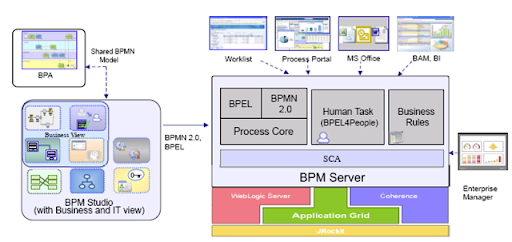
1. 11g BPM Suite release in 2009

2. BPM on BPMN 2.0 specification

3. BPEL PM on BPEL 2.0 specification

4. BPM studio in JDeveloper

5. BPM and BPEL PM will use same human task service based on WS-Human Task and BPEL4People

6.Common process portal built on Oracle WebCenter

7.Common BAM/BI layer

8.Common BPM Server built on SCA, WebLogic Server, JRockit JVM, Oracle Application Grid, and Coherence distributed caching and Enterprise Manager

9.BPM Studio integration with an Enterprise Repository, which automatically creates dependency maps for all modeling/design components checked in.

Oracle TopLink 11g Released

Oracle released its next version of TopLink 11g(11.1.1.0.0) . This is the first release based on the open-source EclipseLink project. (EclipseLink is derived from a previous version of Oracle TopLink)

Features of 11g are

1.Object-Relational Persistence

TopLink 11g includes support for the native TopLink ORM API as well as the Java Persistence API (JPA) through EclipseLink

a. Java Persistence API (JPA) Support ( supports JPA 1.0 spec)

b. JPA Extensions

    • Mappings
    • Mapping Customization
    • Converters
    • Entity Caching
    • Optimistic Locking
    • Query Hints
    • Stored Procedure Query
    • Lazy Loading
    • Schema Generation
    • Returning Policy
    • Change Tracking

c.JPA Configuration

d.Performance Requirements

  • Change tracking for JPA entities
  • Read-only queries
  • Parameter binding: now enabled by default.
  • Joining: additional support for many-to-many, direct-collection, direct-map, and aggregate-collection mappings, and mapping level inner and outer join support
  • Inheritance: support for outer joining inheritance subclasses on queries, and support for joining classes with inheritance
  • Improved performance and concurrency
  • Dynamic Expression and JPQL parse cache

e.Oracle Spatial support

f.Stored procedure configuration in ORM Project.xml

g. Support for SDO (Service data objects) for Java specification version 2.1

JSR311 : JAX-RS : Java API for RESTful Webservices

This JSR provides an API for providing support for RESTful(Representational State Transfer) Web Services in the Java Platform.

This JSR : Final Approval Ballot is done on 22-Sep-2008.

You can find the details of this API here

Not heard of REST ? read it here.

Goals of this API are

POJO-based : The API will provide a set of annotations and associated classes/interfaces that may be used with POJO's in order to expose them as Web resources. The specification will define object lifecycle and scope.
HTTP-centric : The specification will assume HTTP is the underlying network protocol and will provide a clear mapping between HTTP and URI elements and the corresponding API classes and annotations. The API will provide high level support for common HTTP usage patterns and will be sufficiently flexible to support a variety of HTTP applications including WebDAV and the Atom Publishing Protocol.
Format independence : The API will be applicable to a wide variety of HTTP entity body content types. It will provide the necessary pluggability to allow additional types to be added by an application in a standard manner.
Container independence : Artifacts using the API will be deployable in a variety of Web-tier containers. The specification will define how artifacts are deployed in a Servlet container and as a JAX-WS Provider.
Inclusion in Java EE : The specification will define the environment for a Web resource class hosted in a Java EE container and will specify how to use Java EE features and components within a Web resource class

Oracle BPEL PM 10.1.3.4

New features in BPEL 10.1.3.4 includes

1.Improved visibility of Engine Threading Model

Current:

a. Dispatcher page is static

b.Difficult to use when monitoring messages under load

c.Needs to be manually refreshed

d.Lack of messages details in a queue

10.1.3.4:

a.Dynamic, updated in real-time

b.Shows information about

i.Running threads

ii.New invocations that are queued

iii.Incoming calls that are queued.

c.Drill down on each thread to get process id , to see which process messages are coming from

2.Improved Statistics Collection

Current:

a.Statistics collection aggregates the times across all requests, regardless of process or instance

b.Many users find the current statistics page difficult to use for pinpointing bottlenecks, due to aggregation

c.Users need to flip between audit trail and statistics pages

d.Intended to be used by engineering

10.1.3.4

a.Statistics are aggregated on a per-process basis

b.Statistics are displayed on the process map

c.Easy to identify bottlenecks

post 10.1.3.4 (10.1.3.5)

a.Overlay following on process map:

• Transaction boundaries
• XML payload sizes
• Service invocation times

b.Persist statistics

3.Minimize XML Coding Errors

10.1.3.4

a.Test compliance of payload with schemas defined in process/WSDL

b.Reduce debugging effort when incorrect payloads are received by BPEL

c.Only starting invocations in 10.1.3.4

post 10.1.3.4 (10.1.3.5)

a.Validate XML against other schemas from project

b.Test XML against XPath from process

c.Enable unit testing of custom XPath functions

4.Rescuing Lost instances

current

A BPEL instance was started. But nothing appeared in the BPEL
Console or audit trail.Caused by a transaction rollback in certain
circumstances.Analogous to a database rollback

10.1.3.4

a.Detect 3rd party manipulation of the JTA transaction

b.Move audit trail persistence to an asynchronous thread (to increase visibility of errors within the process)

5.Automated Recovery agent

10.1.3.4

a.Implement automated recovery agent for failed activities/messages

b.Improve visibility of errors encountered during recovery by writing them out to the instance audit trail asynchronously

c.Agent can be triggered manually or via schedule
• Schedule during non-busy periods

d.Allow batch limits for each recovery attempt

6.Collection of Support information

10.1.3.4

a.Cut down on round-trips between customer and support/development for debugging information

b.Make BPEL Console single tool admins need to consult

c.Bundles:
• JVM thread dump
• JVM heap statistics
• Dispatcher statistics
• BPEL domain logs
• Request statistics
• Dehydration statistics

d.Can also export BPEL process

7. Deployment Plan

Current

a. Deploying a BPEL project to a different environment (e.g.,
dev, test, production) requires various changes to the project.
For example:
• Location of services
• Port numbers of services
• Location of hosted WSDLs
• Location of hosted XSDs
b.Changes have to be made in various files

c.Changes have to be made manually

d.Often need a different BPEL suitcase for each environment

10.1.3.4

Deployment plan

a.allows users to develop in one environment and then - without touching the source code - deploy the suitcase to another environment

b.holds the configuration for one environment.Instead of managing separate suitcase files, the user generates a deployment plan from a suitcase and modifies the configuration for each environment

c.eliminates the need to provide customized suitcases for each environment

Things to Come in 10.1.3.5

a.BPEL debugger
• Set breakpoints
• Step-by-step
• Introspect and modify XML variables

b.Log viewer
• Search and filter on particular instance

c.Notification
• Engine events like startup, shutdown
• Auto-recovery agents fails to recover
• Process state changes (active to stale, etc)

d.Improve XML validation
• Validate XML against other schemas
• Test process or customer XPath expressions

e.Import/Export instances runtime data
• Offline re-creation

Oracle BPEL PM 10.1.3.4 : Bugs Fixed

Oracle BPEL PM 10.1.3.4 patch fixed some critical bugs . Few of which are of interest to most of us includes

1.When the console is used to clear the wsdlCache, in a load-balanced Clicking clear WSDL cache from the console will now propagate the message to the other nodes in the BPEL cluster. Previously, clicking the button would only affect the single node.

2.NULL POINTER EXCEPTION was thrown when we validate a xml which has null values inside it.

3.Under certain circumstances, when multiple callbacks are received at the same time, the first callback will be processed but the remaining callbacks will throw a "scope not found" error. Fixed by serializing the callbacks.

4.With this fix, Any unhandled exception during a sync call will be returned to the caller.

5.DOMAINS CREATED IN A CLUSTER GETS NOT PROPAGATED TO NEW OR EXISTING NODES

Webservices Versioning

We do versioning on almost everyday while developing various components, be it java, PL/SQL or JSP's. There are well known standards for maintaining these versions. In the SOA world, we often use and develop web services and versioning of these webservices becomes extremely important.

Oracle published an article on OTN with title "Webservices Versioning" written by Gabriel Bechara. You can read the full article here.

BPEL Process Design : Best Practices

Best Practices to be followed while designing BPEL processes.

1.

RBI : Annual Credit Policy

RBI has announced the annual credit policy. here are the quick highlights of the policy.

1. No change Repo rate

2. No change in Reverse Repo

2.CRR hike 25 bps

more to come soon.

BPEL DBAdapter : Using Oracle Native Sequence

Do you know , how to use DBAdapter to insert a record in the database ? Seem's very straight forward . isn't it ?

Yes, in fact it is straight forward. Just configure the database, select the operation (insert,update, merge and delete ) and then map the input's. run the sample and there you go, there is a record in the database. Bang!!!!!!!.

But , the real problem begin, when you have the table which has a primary key. Now either you need to generate a unique ID in the BPEL layer and map it to the DBAdapter message type variables or use a sequence created in the database. Best thing is to use the database sequence . But how to do it ? Is there a documentation or if it exists is it good enough ? For the benefit of this blog readers , here is how I made it to work after spending long hours on the internet and trial and error. I am sure , it will save you a lot of time and if so, just leave your comments.

OK, now the steps to make it work.

1. Create a table with a primary key

2. Create a sequence with start value as 1 and increment by 1

3. Configure the DBAdapter for an insert option.

4. After successful configuration of the DBAdapter, you will find the "offline objects" and toplink mapping created for you.

so far normal. nothing much.. here are the undocumented (not with proper documentation) steps

5. Configure the DBAdapter's oc4j-ra.xml with the following parameters

<connector-factory location="eis/DB/XE" connector-name="Database Adapter">
        <config-property name="xADataSourceName" value="jdbc/XEDataSource"/>
        <config-property name="dataSourceName" value=""/>
        <config-property name="platformClassName" value="oracle.toplink.platform.database.Oracle9Platform"/>
        <config-property name="usesNativeSequencing" value="true"/>
        <config-property name="sequencePreallocationSize" value="1"/>
        <config-property name="defaultNChar" value="false"/>
        <config-property name="usesBatchWriting" value="false"/>
        <connection-pooling use="none">
        </connection-pooling>
        <security-config use="none">
        </security-config>
    </connector-factory>

usesNativeSequencing : Set this to "true" to allow native sequencing

sequencePreallocationSize: This should be the counter that you use for your sequence. (eg : If we created a sequence with increment by 1, so the value of this should be 1). Please note , the default value is 50.

xADataSourceName : datasource name for connecting to the database in the oc4j.

The important steps to come..stay tuned.

Nifty Today : April 28,2008

The market opened on a firm note extending last week's rally. It soon declined into the red, amid mixed Asian markets. The market traded between positive and negative zone in choppy mid-morning trade and declined sharply to hit intra-day low in the mid-afternoon trade. Sugar stocks rose on reports the government may go in for total decontrol in sugar in one go. S&P CNX Nifty closed at 5089.65 down by 22.05 points

Top 3 gainers

1.REL

2.SUNPHARMA

3.TATACOMM

Top 3 losers

1.SIEMENS

2.CIPLA

3.SUZLON

Both FII and DII are the net sellers with Rs 38.33 crores and Rs 166.61 crores respectively.

Top Options contracts trades are

1.RCOM : 580 PA,580 CA and 600 CA

2.RELIANCE : 2600 CA,2700 CA

3.RNRL : 130 CA and 120 CA

IPL Standings after 1st week

Here are how, the teams are standing after end of first week of the inaugural IPL.

Most hyped team "Deccan Chargers" failed  very badly by loosing all the 3 matches played so far and least talked team with low profile of players of "Rajasthan Royals" emerged as surprise winner so far with 2 wins out of 3 played so far.

The next set of matches for DC becomes extremely important to get into semi's.

Here is the points table (source : iplt20

Team Played Won Lost Points Net R/R
2 2 0 4 +3.764
2 2 0 4 +2.988
2 2 0 4 +0.975
3 2 1 4 -0.419
3 1 2 2 -0.241
2 1 1 2 -3.423
3 0 3 0 -1.268
3 0 3 0 -1.339

US Markets Today : April 24th,2008

Very good day for US markets on the back of cooling commodities prices, good earnings and strong dollar. DOW was up by 0.7% and NASDAQ by 1% in today's trade.

Triggers

1. Very good earnings from Microsoft,Apple that topped the estimates.

2.Ford Motors earnings which posted a profit vs loss in the last  quarter, which surprised the Markets.

3.New home sales for March fell to 16 year low

4.US crude oil fall to settle at $116.06

5.Dollar rise vs EURO and YEN

Impact on India

With the start of MAY contracts and positive cues from US and Asian Markets, we could expect a gap up opening today. Nifty can touch 5100 levels and can trade above till at least afternoon.Its interesting to see if Bharti,Cipla and Siemens can post good Q4 numbers today or not. There is chance to play in F&O segment in Bharti today considering the good numbers from telecom major Idea Celular yesterday. Also one can buy PUTs in NIFTY for 5150,5200 contracts for a premium of 50,150 respectively to get good gains this month.

Nifty Today : April 24th,2008

The market had opened firm on positive global cues. However, it pared gains later. The market which oscillated in narrow range for a better part of the day, dipped into the red in mid-afternoon trade. Trading was choppy ahead of the April 2008 derivatives expiry today. S&P CNX Nifty closed at 4999.85 down by 22.95 points.

Top 3 gainers

1.HEROHONDA

2.INFOSYSTCH

3.TATAPOWER

Top 3 Losers

1.ACC

2.NATIONALUM

3.POWERGRID

FII are the net sellers with Rs 759.16 Crores and DII are the net buyers with Rs 442.88 Crores.

Top Options Contracts traded are

1.DLF : 680 PA, 680 CA

2.ICICIBANK : 900 CA

3.RELIANCE : 2700 CA,2600 CA,2600 PA

4.RPL : 190 CA and 195 CA

Maruti Q4 numbers

Maurti Q4 numbers are out and they seem to be inline with the market expectations.

Here are the highlights.(Numbers are all in Crores of Rupees)

1. Q4 Standalone Net Sales at 4783.88 compared to 4429.76 in Q3

2. Q4 Standalone Net Profit at 297.68 compared to 448.56 in Q3

3. Depreciation at 311 compared to 71.8

4. Other Income at 286 compared to 206

5. Depreciation period is cut from 13 years to 8 years

6. FY08 Consolidated Net Sales at 18,104.1 compared to 14,768.4 FY07

7. FY08 Consolidated Net Profit at 1789.9 compared to 1588.3 FY07

8. FY08 EBITDA at 313

VIX - What is It and How to use It ?

source : Nse India

VIX - Volatility Index , is a measure of market’s expectation of volatility over the near term

Volatility Index is a measure, of the amount by which an underlying Index is expected to fluctuate, in the near term, (calculated as annualised volatility, denoted in percentage) based on the order book of the underlying index options.

Volatility Index is a good indicator of the investors’ perception on how volatile markets are expected to be in the near term. Usually, during periods of market volatility, market moves steeply up or down and the volatility index tends to rise.

India VIX is a volatility index based on the Nifty 50 Index Option prices.From the best bid-ask prices of Nifty 50 Options contracts, a volatility figure (%) is calculated which indicates the expected market volatility over the next 30 calendar days.

There are some differences between a price index, such as the Nifty 50 and India VIX. Nifty 50 is calculated based on the price movement of the underlying 50 stocks which comprises the index.India VIX is calculated based on the bid-offer prices of the near and mid month
Nifty 50 Index Options

How to use VIX

1.Investors could hedge their portfolios against volatility with an off-setting position in India VIX futures or options contracts

2.Investors could also use the implied volatility information given by the index, in identifying mis-priced options.

3.Short sale positions could expose investors to directional risk. Derivatives on volatility index could help investors in safeguarding their positions and thus avoid systemic risk for the market.

4.Based on the experience gained with the benchmark broad based index, sector specific volatility indices could be constructed to enable hedging by investors in those specific sectors.

US Markets today : April 23,2008

For US Markets its a Mixed today with DOW at the early part of the day up by more than 100 points , and then cooled down to settle at just above 43 points from yesterday's close. NASDAQ also up by 1.19%(28.27)

Triggers

1.Better than expected results from Boeing

2.Anticipated good news from Tech sector results which are due for tomorrow.

3.Apple reported growth in profit and sales which were above the market's expectations and so as Telecom company Qualcomm.

4.Crude oil rise to settle at $118.30

Impact On India

After good show from yesterday in spite of weak global cues, today Market's can get some investors confidence to do a gap up opening. Being the last day for April F&O contracts, there are chances of some volatality during the day. Indian VIX for 23rd April is at 32.37. I feel Markets can trade in the range of 5000 - 5100 till April 29, and take direction from there on either side based on the RBI policy.

Nifty Today : April 23,2008

The market opened on a firm note but soon slipped in the red on profit booking after six straight days of rally. Banking stocks saw selling pressure. It failed to sustain higher level after a strong rebound from lower level was witnessed in mid-afternoon trade. S&P CNX Nifty closed at 5022.80 down by 26.50 points.

Top 3 Gainers in NIFTY

1.INFOSYSTCH

2.WIPRO

3.ACC

Top 3 Losers in NIFTY

1.SAIL

2.IDEA

3.HDFCBANK

FII are the net sellers in today's market with Rs 480.93 Crores and DII are the net buyers with 70.04 Crores

F&O segment

Most Active Options contracts are

1. RELIANCE 2600 CA , 2600 PA

2. RPL 190 CA,200 CA

3. RNRL 120 CA

IT and FY09 Guidance

The results of Biggies in IT are out and Market reacted positively after Infosys announced its quarter numbers and lifted the whole Market with it. But then TCS come out with the numbers and exact opposite thing happened as it dragged IT index by more than 5% .

Here is the quick comparison for you, which clearly states Infosys and Satyam as hot favorites for IT sector in the coming quarters

Company FY09e EPS P/E
Infosys 95.20 17.3x
TCS 60.90 16.3x
Satyam 30.40 15.1x
Wipro 26.90 16.8x
HCL 21.70 12.6x


P/E - Price/Earnings ratio

FY09e EPS - FY09 expected earnings per share

BlackBerry : DOT solution

If you are the BlackBerry services user in India, then may be soon DOT will allow you to do what you been doing all these days in India.

As per ET(Economic Times) Department of Telecom DOT, has proposed an interim solution where all data between BlackBerry users are stored on the servers of Tele companies like Bharti,Vodafone etc.

BlackBerry's maker RIM sought more time to respond to the DOT's request as it is hesitant to move the servers from Canada to India.

This solution is to allow the securities to monitor the traffic for the proposed 12 months and take the final call based on the monitoring results.

Read more here BlackBerry

US Markets today : April 22,2008

Once again, US markets traded in the red with the fears of bad earnings reports and every day new high crude oil prices. DOW lost by 100 points(0.82%) and NASDAQ by 31 points(1.29%) in today's trade.

Triggers

1. New high's of crude oil

2. Dollar slippage to new record low against EURO

3. Dollar fallen against YEN

Impact on India
With the negative cues which have come from US today, we can see almost a flat opening today and can trade in the same range as yesterday. I think , the next immediate trigger for Indian markets would be the policy announcement from RBI which is due for 29th of this month and till that time, it looks like NIFTY will stay above 5000 and can trade in the range of 5000-5100. As a whole , I am bearish for the month of MAY which can see major correction as seen in the  year of 2006 and plan to hedge my portfolio through PUT's in NIFTY. I strongly feel that 5300 PUT @ 150-200 can fetch you good profit for the month of MAY.

What's your strategy ? leave your comments ...